vendor-invoice-qa-assistant
Vendor Invoice Digitization & QA Assistant
A local, network-free portfolio MVP that turns synthetic vendor-invoice PDFs into validated structured records, routes uncertain or invalid results to a human reviewer, keeps append-only evidence, and exports approved data.
Synthetic data only. Not production software. No claim is made about real-world accuracy, regulatory compliance, customer usage or time savings.
Live demo: vendor-invoice-app-assistant on Streamlit Community Cloud. No PDF needed: on the Upload page, pick a sample invoice and click Run sample. The hosted demo shares one database across visitors and starts empty again when the app restarts.
1. Overview
Streamlit UI over plain-Python services, a domain layer with exact Decimal/date rules, and
a local SQLite database. Extraction is deterministic (no model, no network). An AI-provider
protocol, a test-only fake and a Pydantic validation boundary demonstrate structured-output
handling; no real provider is connected.
2. Business problem
Accounts-payable and operations teams re-key semi-structured vendor invoices. Manual entry is slow and error-prone (identity, date, currency, tax, arithmetic, duplicates, PO references), while fully automatic extraction is risky on unfamiliar layouts, conflicting values or low confidence. This demo shows a controlled middle path: automate the clean cases, make every exception visible, and require a deliberate human approval.
3. Intended user
A non-technical operations analyst who uploads invoices, reviews exceptions, compares raw and normalized values, corrects or confirms fields, approves valid records, rejects invalid ones, and exports approved data.
4. Workflow
Synthetic PDF -> file-security checks -> deterministic text extraction -> raw field evidence
  -> exact normalization -> validation + duplicate detection -> exception-based review
  -> approve / reject -> approved CSV/JSON export -> append-only audit history + metrics
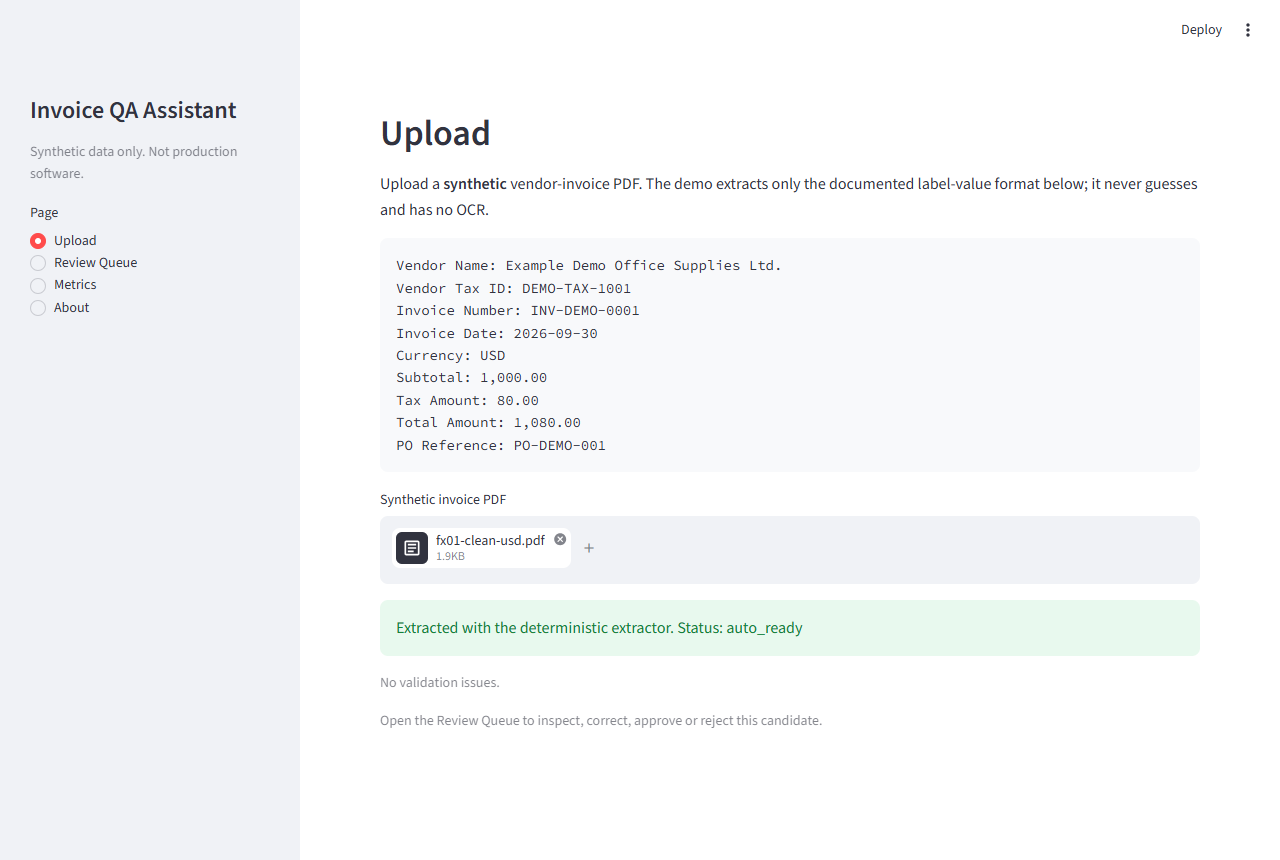
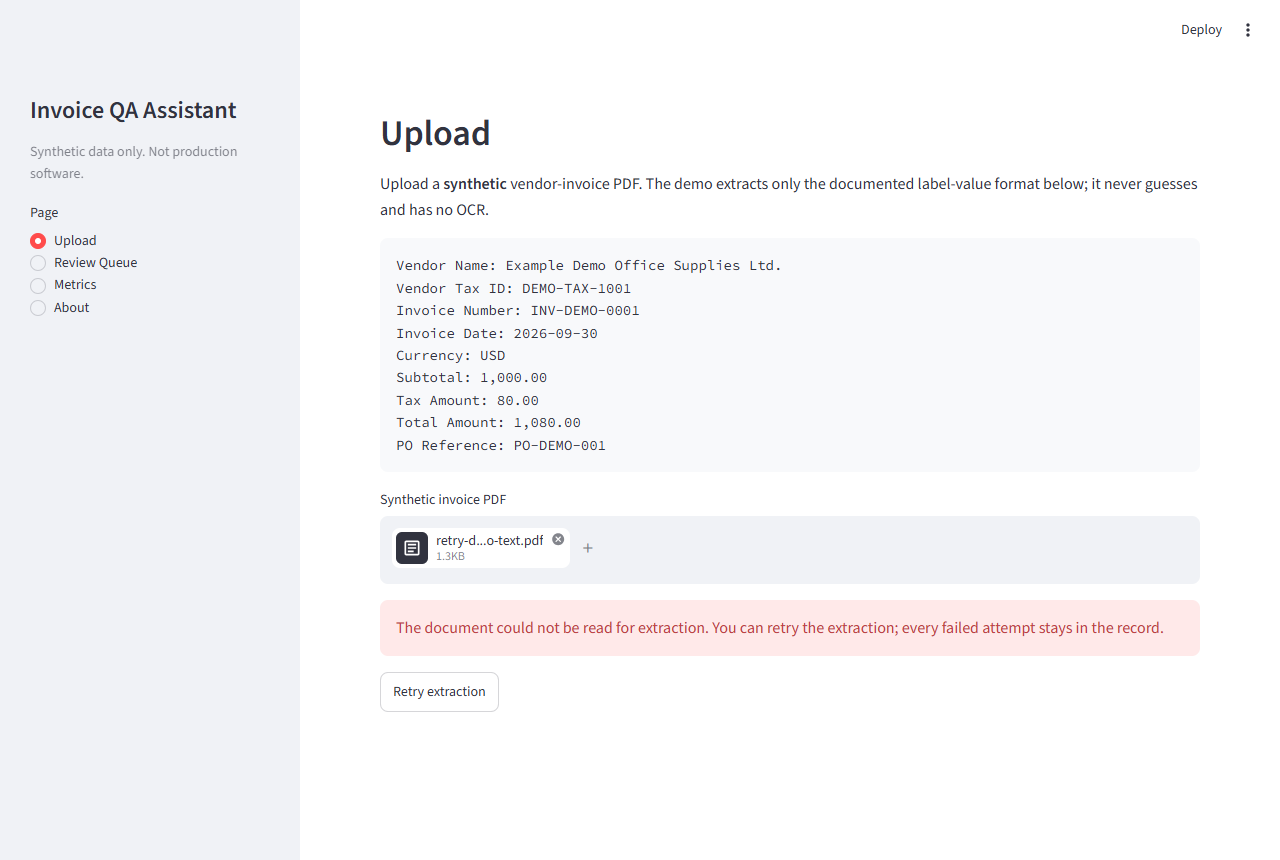
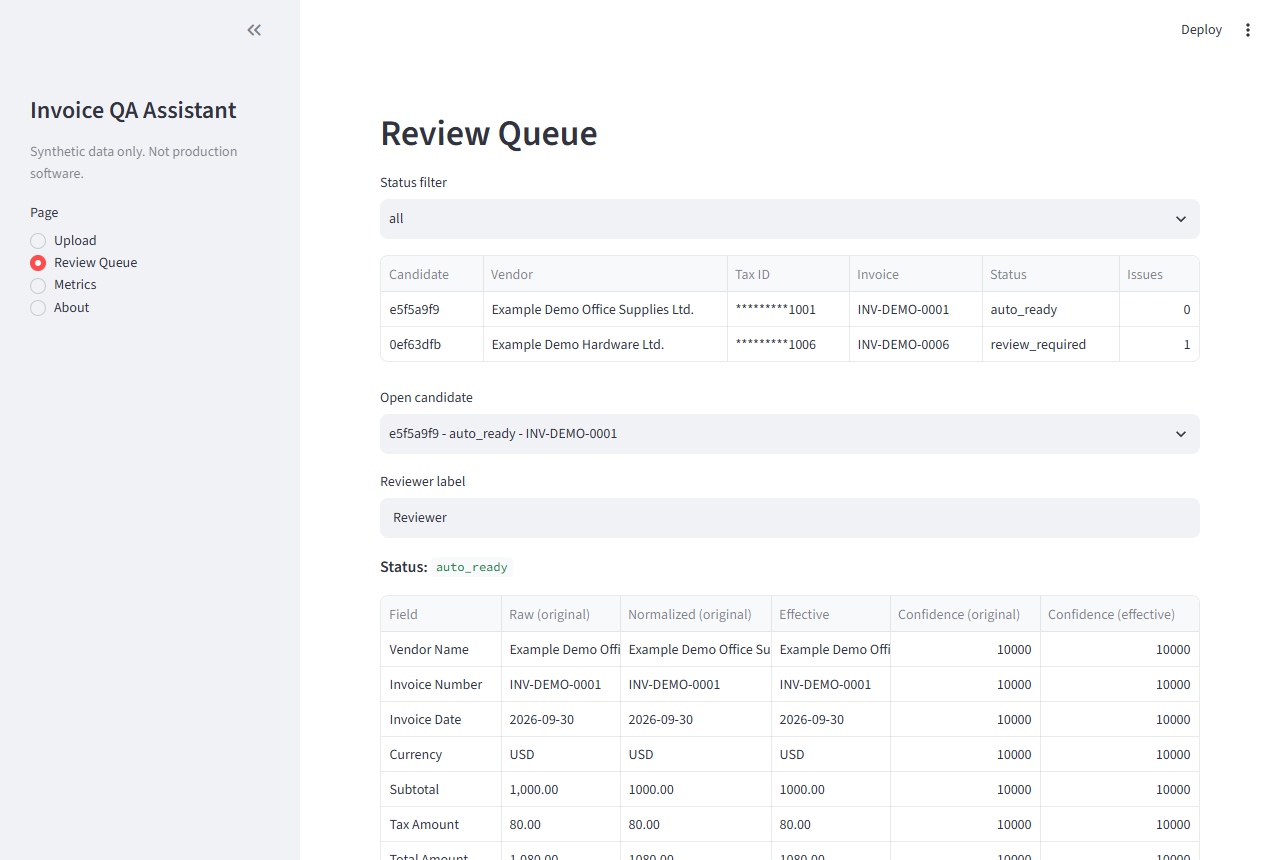
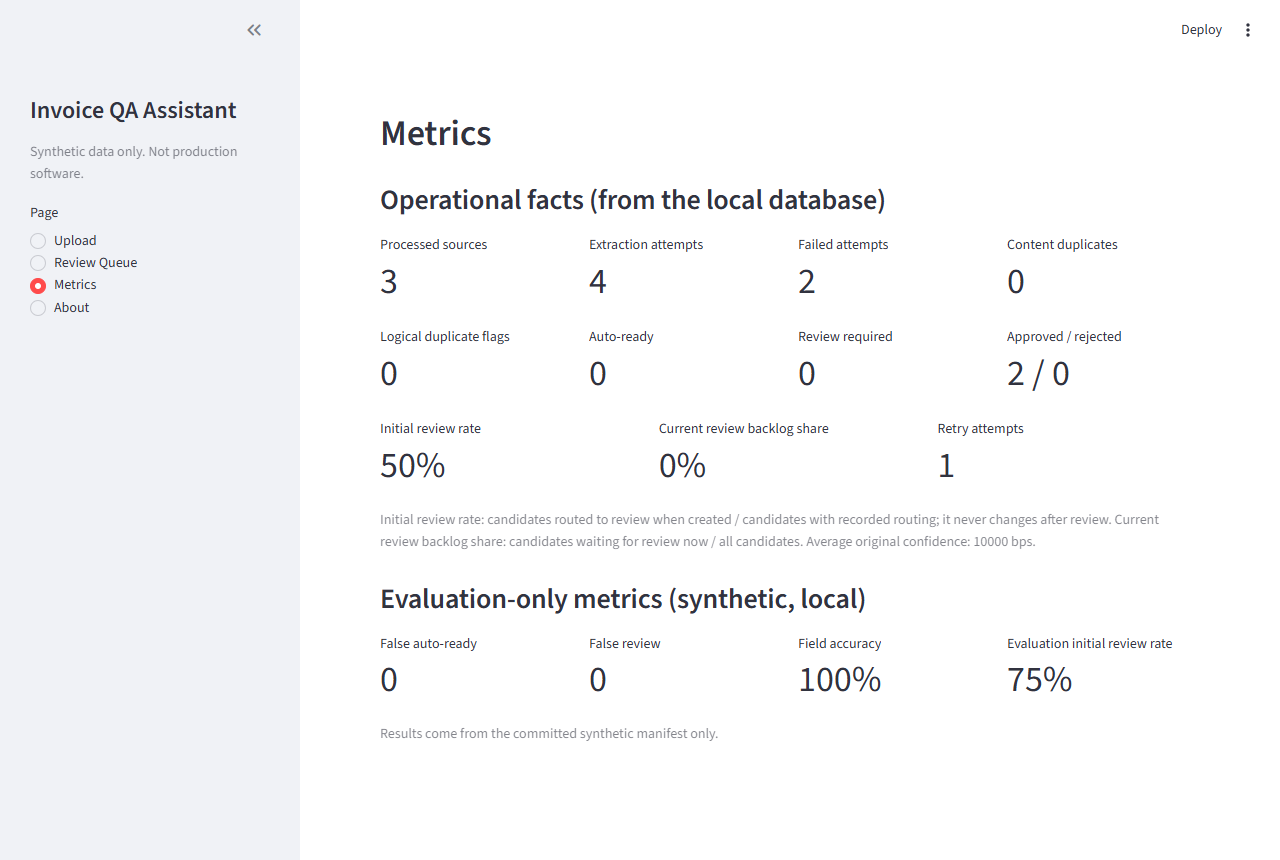
Demo screenshots
| Clean invoice upload | Explicit extraction retry |
|---|---|
 |
 |
| Human review queue | Operational and evaluation metrics |
|---|---|
 |
 |
5. Features
- Upload, Review Queue, Metrics and About pages.
- Raw vs. original-normalized vs. effective value comparison with original and effective confidence.
- Field-level correction errors, confirmation of low-confidence fields only, duplicate resolution, approval with re-validation, rejection with a reason.
- Content-duplicate and logical-duplicate handling. A document that is already known never extracts again on its own; after an extraction error the user can choose Retry extraction. Every attempt (failed, interrupted or successful) is kept as an immutable, numbered row. A successful extraction and its candidate are written in one database transaction, so a succeeded attempt never exists without its candidate. An attempt that is still running (younger than 10 minutes) is never interrupted by a second session; the UI says extraction is already in progress.
- Metrics separate the initial review rate (routing recorded when the candidate was created, never rewritten) from the current review backlog share (waiting for review now).
- Approved-only export (CSV/JSON) with masked vendor tax IDs.
- Reproducible 13-scenario synthetic evaluation with false-auto-ready / false-review counts.
6. Architecture
app.py                     Streamlit entry point (sidebar navigation)
src/invoice_qa/
  domain/                  models, normalization, validation, transitions (no I/O)
  extraction/              Extractor protocol, DeterministicExtractor, AI boundary
  infrastructure/          SQLite repository, file-security checks
  services/                intake, review, metrics, export
  ui/                      page renderers and display helpers
  synthetic.py             deterministic PDF builder shared by tests and the generator
sample_data/, scripts/     manifest, generator, evaluator
A short-lived SQLite connection is opened per repository operation. “Today” is injected through a clock dependency; domain and service code never read the system clock.
7. Validation and confidence rules
- Supported currencies:
USD,EUR,GBP,SGD,VND. Dates accept ISOYYYY-MM-DDonly. - Amounts must match
^[+-]?(\d{1,3}(,\d{3})+|\d+)(\.\d+)?$; locale variants such as1.000,00are malformed, never inferred. - Allowed fractional digits:
VND0, others 2. Fewer digits are padded exactly; more digits aremalformed_value. Nothing is ever rounded. - Vendor tax IDs must match
DEMO-TAX-\d{4}after trim and uppercase. - Blocking issues:
missing_required_field,malformed_value,unsupported_currency,future_invoice_date,invalid_amount_sign,arithmetic_mismatch,conflicting_values,possible_logical_duplicate. Review warnings:low_field_confidence(< 8000 bps),low_overall_confidence(< 8500 bps). Advisory:missing_po_reference. - Confidence is in integer basis points (
10000= 100%): exact label 10000, documented alias 9000, loose alias 7500 (one field only), missing or conflicting 0. Overall confidence is the floor mean over the seven required fields. - The overall-confidence warning is not a frequent gate: because only one field can use the 7500 loose alias, it fires only when a required field is missing or conflicting and another required field is also below 10000 (for example 8428).
8. Human-in-the-loop controls
- A clean candidate becomes
auto_readybut still needs a deliberate human approval. - Confirmation resolves only
low_field_confidence; blocking issues need a valid correction. - Approval re-runs validation and duplicate detection; a newer duplicate blocks approval,
returns the candidate to
review_requiredand records anapproval_blockedevent. approvedandrejectedare terminal. Reopen is production hardening.- Corrections and events commit atomically; SQLite triggers reject
UPDATE/DELETEon review events and any change to original evidence.
9. Security and privacy
See SECURITY.md. In short: PDF only, at most 5 MiB (enforced by the Streamlit widget, server config and the application), non-encrypted, structurally readable, at least one page; PDF bytes and full extracted text are never stored; vendor tax IDs are masked outside an explicit session-only edit action; UI errors are generic.
10. Synthetic evaluation methodology and measured results
sample_data/manifest.json defines 13 fixtures (clean USD, clean VND, no PO, missing invoice
number, unsupported currency, malformed amount, arithmetic mismatch, future date,
low-confidence alias, conflicting total, content duplicate, logical duplicate, excess
fractional digits) with expected normalized values, confidence, exact issue-code sets and
initial status. scripts/evaluate.py processes them in manifest order against a fresh
temporary database with a fixed reference date.
Measured on 2026-10-10 (synthetic, local; code baseline in REVIEW_HANDOFF.md):
| Metric | Result |
|---|---|
| Scenarios matching the manifest | 13 / 13 |
| Field-level accuracy (fields with defined ground truth) | 111 / 111 |
| Initial review rate (review_required at creation / new candidates) | 0.75 (9 of 12) |
| False auto-ready | 0 |
| False review | 0 |
These numbers describe a small, hand-built, synthetic set whose expectations were written alongside the rules; they are a regression check, not evidence of real-world accuracy.
11. Local setup
Requires Python 3.11 or newer.
python -m venv .venv
.venv/Scripts/python -m pip install -e ".[dev]"     # Windows; use .venv/bin/python elsewhere
.venv/Scripts/python -m pytest -q
.venv/Scripts/ruff check .
.venv/Scripts/python sample_data/generate_samples.py
.venv/Scripts/python scripts/evaluate.py --manifest sample_data/manifest.json --output .evaluation/report.json
.venv/Scripts/streamlit run app.py
Configuration is read from the process environment only (.env.example documents
INVOICE_QA_DB_PATH; no dotenv loader). Default database: .data/invoice_qa.sqlite3
(gitignored).
12. Demo walkthrough
- Run the generator (13 evaluation PDFs plus the no-text retry sample), then start the app.
- Upload
sample_data/generated/fx01-clean-usd.pdf; it routes toauto_ready. - Upload
fx06-malformed-amount.pdf; open the Review Queue, correctSubtotalto1,000.00and watch the status change. - Upload
fx09-low-confidence-alias.pdf; confirmvendor_name(the only confirmable field). - Upload
fx12-logical-duplicate.pdf; resolve it by rejecting or confirming distinctness. - Approve a candidate, then download the approved CSV/JSON from the Review Queue.
- Open Metrics: Initial review rate stays where it was after you approve or reject, while Current review backlog share falls; run the evaluator command shown there to populate evaluation-only numbers.
- Extraction retry (see
screenshots/03-extraction-error-with-retry.pngandscreenshots/04-after-manual-retry.png): uploadsample_data/generated/retry-demo-no-text.pdf(written by the generator, a valid PDF with no text layer). The page shows an extraction error and a Retry extraction button. Nothing retries until you click it; each click adds a numbered attempt and keeps the failed ones (it fails again here by design, because the file never has text). Metrics then show the failed attempts and retry attempts.
13. Known limitations
- Only the documented label-value format is supported; no OCR, no fuzzy matching.
- Retry is manual only (no automatic retry, backoff or limit on attempts). The PDF is never stored, so a retry needs the same file uploaded again.
- A
startedattempt younger than 10 minutes (STALE_ATTEMPT_AFTERininfrastructure/database.py, measured with the injected database clock) is treated as running: a second session gets an “already in progress” result and changes nothing. Only an attempt at least 10 minutes old is preserved asextraction_interruptedwhen the user retries. The threshold is a fixed guess, not derived from measurements; an extraction that really runs longer than that could still be interrupted, and a crashed one blocks retry for up to 10 minutes. - A succeeded attempt that has no candidate (only possible from data written before extraction and candidate creation became one transaction) is repaired on the next upload or retry of that file by rebuilding the candidate from the stored raw extraction; the PDF is not re-extracted. The rebuilt candidate is validated against today’s date and the current duplicates.
- A database created before retry existed is upgraded in place on first start; its candidates have no recorded initial routing and are excluded from the initial review rate.
- Uploads rejected by file-security checks are shown to the user but not counted in metrics.
- No authentication, roles, multi-tenancy or retention policy.
- Out of scope: credit notes, multi-rate VAT, withholding tax, rounding adjustments, multi-currency invoices, email ingestion, ERP/payment integrations, real AI providers.
- Fixture byte reproducibility holds only for the pinned ReportLab version.
- Verified locally on Python 3.14.6 and 3.11.15 (Windows 11, full test suite, Ruff and the evaluator on both). Other platforms and Python 3.12/3.13 for this revision were not run.
- Screenshots in
screenshots/come from one scripted browser run on synthetic data; no manual browser session was performed.
14. Production hardening (not done)
Authentication and RBAC, managed database and retention, monitoring and alerting, a reopen flow, automatic retry policy, OCR, ERP integration, real-provider integration with its own threat model, and a legal/privacy review.
15. Dependency licenses
Direct dependencies: Streamlit, pypdf, ReportLab, Pydantic, pandas (runtime); pytest, Ruff (development). pypdf and ReportLab are permissive open-source libraries. This is not legal advice; confirm licenses before redistribution.
16. Project license status
Licensed under the MIT License.